

Kling AI is one of the most technically capable AI video generators available today, and on pure output quality — motion physics, character consistency, native 4K, and multilingual lip-sync — it competes with or beats Google Veo, Runway, and Sora-class systems, a standing confirmed by its consistent top-tier placement on the Artificial Analysis Text-to-Video Leaderboard. The catch is everything around the model.
The credit-based pricing structure is genuinely difficult to budget against, third-party trackers report inconsistent generation success rates, and the platform’s billing and customer support record is one of the worst in the AI tools category, based on hundreds of independently verifiable Trustpilot complaints against Klingai.com.
Kling AI earns a strong recommendation for its generation quality and a much more cautious one for its business practices. Treat this as a tool worth using, not a subscription worth trusting blindly.
What Is Kling AI?
Kling AI is a generative video and image platform built by Kuaishou Technology, the Beijing-based company behind China’s second-largest short-video app.
Kuaishou launched the first version of Kling in June 2024, and it has since become the flagship product of Kuaishou’s AI research division, known internally as KwaiVGI, a history documented in detail on the Kling AI Wikipedia entry.
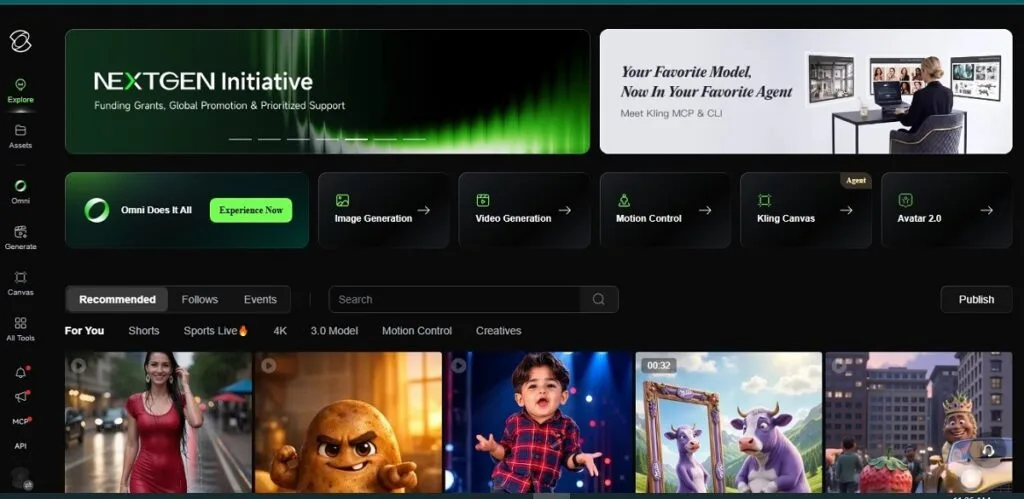
The platform is accessible through the official Kling AI web app, iOS and Android apps, and a separate developer API.
Kling sits in the AI video generation category, alongside Google Veo, OpenAI’s Sora, Runway, and ByteDance’s Seedance. Its primary purpose is turning text prompts or still images into short-form video with realistic motion, and its secondary capabilities span image generation, video editing, digital human avatars, and virtual try-on.
The target audience is broad: independent creators making social content, marketing and advertising teams producing branded video, filmmakers prototyping shots, and developers building video generation into their own products via the API.
Core Capabilities and Major Features of Kling AI
Kling’s model lineup has moved quickly since launch. Early versions (1.0 through 1.6) established the platform’s baseline text-to-video and image-to-video quality.
Kling 2.0 and 2.1 extended maximum clip length and added start/end frame keyframing. Kling 2.5 Turbo improved generation speed, and Kling 2.6 introduced native audio-video generation, letting the model produce synchronized sound rather than requiring a separate audio pipeline. Kling O1 added scene extension and forward/backward video continuation.
The current flagship, Kling Video 3.0, launched in February 2026 on what Kuaishou calls the Omni One architecture. It unifies text-to-video, image-to-video, and video editing in a single model, and Kuaishou states it uses 3D spacetime joint attention to model physical behavior — gravity, contact, and material weight — more accurately than earlier diffusion-based approaches.
Kling 3.0 supports clips up to 15 seconds, native 4K output at up to 60fps (which Kuaishou markets as the first native 4K video model on the market), and multilingual lip-sync across seven languages.
Beyond core video generation, the platform includes:
- Kling Motion Control for directing camera paths and character movement
- Digital Human feature for generating lifelike avatars from a photo and voice input
- Virtual Try-On for fashion and product visualization
- Restyle tool for applying visual effects to existing footage
- Multi-Shot generation that produces up to six connected shots with consistent audio and character identity in a single pass
- Text-to-image generation is also included, built on the Image 3.0 and Image 3.0 Omni models, with support for 4K image output and batch-consistent image series.
Performance and Output Quality of Kling AI
On independent benchmarks, Kling holds up well. Artificial Analysis’ model comparison data for Kling 3.0, a widely cited third-party video model evaluator, has repeatedly placed Kling 3.0 in the top tier of its blind-vote Video Arena leaderboard, and Kuaishou has publicized a number-one ranking in the “1080p Pro” category as of February 2026.
Rankings shift quickly in this category — ByteDance’s Seedance 2.0 and Alibaba’s HappyHorse-1.0 have both traded top spots with Kling through early-to-mid 2026 — but Kling consistently sits among the four or five strongest video models available for general use, with particular strength in physically plausible motion and multi-shot consistency.
Real-world usage tells a more mixed story. This in-depth Kling AI reviews roundup covering powerful features and critical flaws describes a meaningful gap between benchmark performance and everyday reliability, with generation success rates commonly cited in the 60–70% range. This means three or four out of every ten attempts produce a result that doesn’t match the prompt, freezes at 99% completion, or comes out visually distorted.
This inconsistency matters more on Kling than on some competitors because, on the consumer web interface, failed generations still consume credits, with no automatic refund documented in the platform’s public policies.
User Experience and Interface
The web interface follows a familiar prompt-box layout: choose text-to-video or image-to-video, write or upload your input, set aspect ratio and duration, and generate. Kling supports the standard social aspect ratios (16:9, 9:16, 1:1) without requiring separate exports.
The onboarding curve is gentle for basic generation, but the credit economy adds a layer of complexity that less technical users often find confusing — credit costs vary by resolution, duration, and whether native audio is enabled, so the same monthly plan can produce very different output volumes depending on settings, as broken down in this complete guide to Kling AI pricing plans and credit costs.
Queue times are a recurring friction point in user reports, particularly for free-tier users during peak hours, while paid tiers include fast-track or priority processing that reduces wait times.
The mobile apps mirror the web experience and hold a 4.7-star rating on the Apple App Store, according to Kuaishou’s own marketing figures, though this figure has not been independently verified against Kling’s Trustpilot record, which sits considerably lower.
Kling AI’s Ecosystem, Integrations, and API Availability
Kling AI provides a full developer API, documented separately from the consumer web platform on the Kling AI Open Platform. The official Kling AI API authentication documentation specifies JWT (JSON Web Token) authentication. This means developers generate an Access Key and Secret Key from the developer console, sign a short-lived token (valid for 30 minutes) using the HS256 algorithm, and pass it as a Bearer token on each request.
Generation requests are asynchronous — you submit a task and poll a separate endpoint for the result — which is standard practice for compute-heavy video generation.
Kuaishou does not appear to publish a first-party SDK with the same prominence as its REST documentation; most Python and Node.js wrappers found in public repositories are community-maintained rather than officially supported, so developers should verify SDK support directly against the current developer docs before committing to one.
There is no publicly documented native plugin for mainstream editing software such as Adobe Premiere or DaVinci Resolve. Instead, Kling models are widely accessible through third-party aggregator platforms — including fal.ai and several API resellers — which bundle Kling alongside competing models under a unified interface, often at different per-second pricing than Kuaishou’s own API packages.
Automation and Collaboration Features
Paid consumer tiers include batch generation, which lets creators queue multiple variations without manual resubmission, and unlimited task queuing rather than the strict serial generation imposed on free accounts.
The platform does not offer real-time multi-user collaboration features such as shared projects, comments, or team workspaces in the way some competing creative tools do; account-level access is largely single-user, with team or agency use typically handled through separate seats rather than a shared workspace.
Customization Options
Creators can steer output using text prompts, negative prompts (to explicitly exclude unwanted elements), reference images or short video clips for character and product consistency, and start/end frame keyframing to define an exact visual transition.
Motion Control extends this further with explicit camera path direction — pans, tilts, zooms, and tracking shots — and character performance capture for digital human generation. This level of directable control is genuinely a differentiator relative to simpler prompt-only video tools.
Kling AI’s Security, Privacy, and Data Handling
Kling AI’s official privacy policy states that user data, including uploaded photos, audio, and video, is stored on servers located in Singapore, with support, engineering, and content-moderation functions distributed globally.
The policy states that personal information is not used for model training beyond what is disclosed in the policy itself, though separate terms-of-service language grants Kuaishou a broad, sublicensable right to use generated Content — meaning both inputs and outputs — for improving, developing, and researching new products and functions.
This independent AI privacy and data-practices assessment of Kling AI gave the platform’s public policy documents a “B” grade, noting a revocable opt-out for model training use, standard access and deletion rights, and comparatively vague data-retention timelines.
Because Kuaishou is a Beijing-headquartered company, data handling is also shaped by China’s Personal Information Protection Law (PIPL) alongside the GDPR-style rights the privacy policy references for international users.
Enterprise or regulated users with strict data-sovereignty requirements should review Kling’s current terms directly before uploading proprietary or sensitive material, since the stated data flows involve both Singapore-based storage and globally distributed operational teams.
Content Moderation and Compliance
Kling’s generation filters are notably stricter than many Western competitors on political content. The Kling AI Wikipedia entry’s sourced history of the platform describes the platform blocking prompts related to protests, government criticism, and other politically sensitive topics, in line with Chinese content regulations including the Generative AI Service Management Provisions.
NSFW and explicit content is also blocked with no adult-mode toggle. For brand-safe commercial and entertainment use cases, this conservative moderation is rarely an obstacle; for documentary, political commentary, or journalism-adjacent work, it can be a hard limitation.
Deployment Options and Platform Support
Kling is a cloud-hosted SaaS product with no self-hosted or on-premise deployment option identified in its public documentation. Access is available through the web platform, native iOS and Android apps, and the developer API.
There is no published enterprise on-premise or private-cloud offering comparable to what some competitors provide for regulated industries; Kuaishou’s enterprise tier instead focuses on procurement, asset management, and compliance support layered on top of the same hosted infrastructure.
Developer Experience
Developer sentiment on Kling’s API documentation is mixed. The authentication flow (JWT signing with a 30-minute token expiry) is standard for experienced backend developers but adds friction compared to a simple static API key, and several third-party guides exist specifically to compile scattered official documentation into a single practical reference — a sign that the official docs are not always considered sufficient on their own.
On the positive side, failed API-side generations do not consume prepaid credits, which is a meaningfully better economic model for experimental or iterative development than the consumer web interface offers.
Company Background and Product Evolution
Kuaishou Technology’s corporate history on Wikipedia records that the company was founded in 2011 in Beijing by Cheng Yixiao and Su Hua, initially as a GIF-sharing app before pivoting to short-form video in 2013.
The company went public on the Hong Kong Stock Exchange in February 2021. Kling launched publicly in June 2024 and iterated rapidly: version 1.6 in December 2024, 2.0 in April 2025, 2.1 in May 2025, 2.6 with native audio later in 2025, and the current 3.0 generation in February 2026.
Kling’s commercial trajectory has been unusually fast. Reported annualized revenue climbed from roughly $150 million in December 2025 to approximately $300–500 million by mid-2026.
According to financial press coverage of Tencent’s backing of Kuaishou’s $2.8 billion Kling AI funding round and reporting on Kling AI’s $20 billion spin-off valuation talks, and Kuaishou has reportedly been in discussions to spin off the Kling AI business unit as an independently funded entity at a valuation in the $15–20 billion range, with investors including Tencent. As of this review, that spin-off remained in a preliminary, unconfirmed stage.
Strengths Demonstrated Throughout Usage
Kling’s clearest strength is motion realism — independent benchmarks and hands-on reviewers consistently rate its handling of physical movement, fabric, water, and camera dynamics above most competitors at a comparable price point. Its feature breadth is also a genuine advantage: few competing platforms combine text-to-video, image-to-video, native audio with lip-sync, digital humans, virtual try-on, and native 4K under one subscription.
The pace of iteration has been fast enough that features which were missing a year ago — synchronized audio, longer clip durations, motion control — have generally arrived within one or two release cycles.
Notable Limitations of Kling AI
The most consistent and well-documented weakness is not the model itself but the business layer around it. Independent Trustpilot aggregates for Kling’s kling.ai customer service review page, among its various review domains, show ratings in the 1.3–2.8 out of 5 range, driven overwhelmingly by billing disputes, difficulty canceling subscriptions, unresponsive support, and monthly credit expiry that many users experience as a hidden cost.
Generation reliability, while strong on curated benchmarks, is reported as inconsistent in day-to-day use, and the platform’s strict, China-aligned content moderation will be a hard blocker for certain use cases. Kuaishou’s parent-company location and stated data flows through Singapore-based servers are also worth factoring in for privacy-sensitive or regulated workflows.
Suitable Use Cases
Kling AI is well suited to social media and short-form marketing video, product and fashion visualization through virtual try-on, agencies producing branded content at volume on the Premier or Ultra tiers, filmmakers previsualizing shots before a full production, and developers building video generation into a product where the async API’s fail-safe credit model reduces experimentation cost.
It is a strong fit for anyone whose priority is motion quality and feature depth over predictable, low-friction billing.
Where Another Tool May Be Preferable
Buyers who need dependable customer support, transparent and rollover-friendly billing, or fewer content restrictions on political and sensitive topics may be better served elsewhere — Runway’s Gen-4.5 line, for instance, offers an unlimited generation tier at higher subscription levels that can outperform Kling on pure per-video cost for high-volume users.
Teams needing talking-head presenter video specifically should look at purpose-built tools such as HeyGen or Synthesia, which are more refined for that narrow use case than Kling’s broader Digital Human feature.
Organizations with strict data-sovereignty requirements around Chinese-owned platforms should also weigh Kling’s ownership and data-flow disclosures carefully against their own compliance obligations before adopting it for regulated or confidential work.