What Redbubble Is and How Artists Earn From It
Redbubble is an online marketplace where independent artists sell their designs on printed products. It was founded in Melbourne in 2006, and its parent company is now Articore Group, which also owns TeePublic. Roughly 650,000 artists sold at least one product on Redbubble in fiscal 2023. The parent renamed itself from Redbubble Group in November 2023.
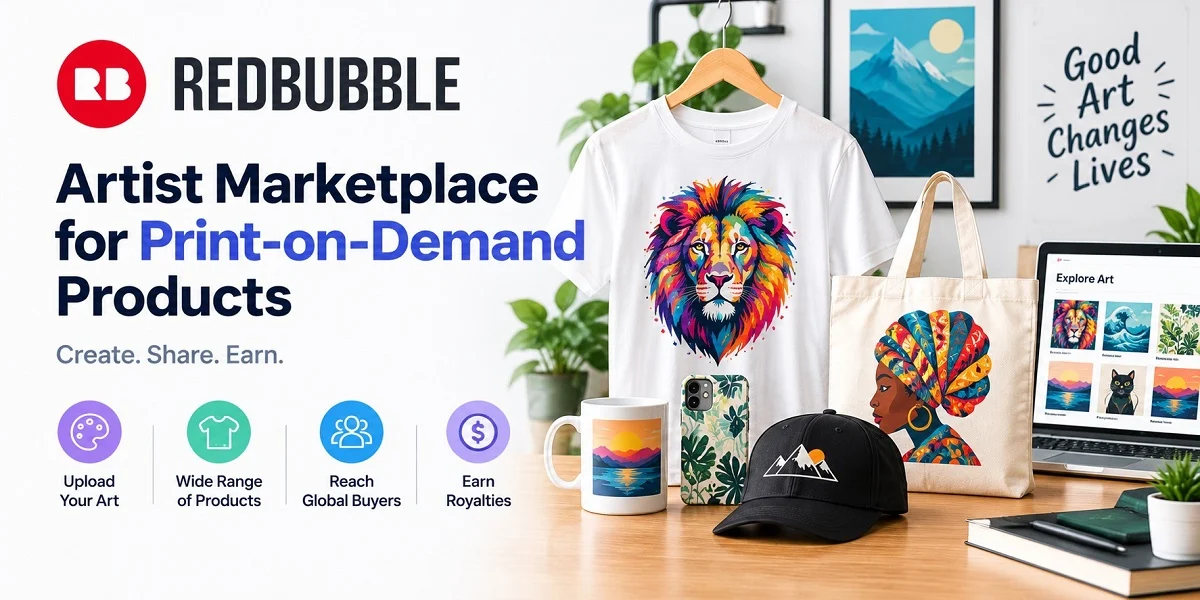
Opening a shop is free, and artists upload art, choose products and set a markup. Redbubble handles production, shipping and customer support through third-party fulfillers. Artists keep the copyright to their work and track earnings in a dashboard.
Each product’s retail price equals a base price plus the artist’s margin. The base price covers Redbubble’s service fee and the manufacturer’s charge. Markup defaults to 10 percent, and artists can raise or lower it for each product.
A $20 base price with a 20 percent markup produces a $24 retail price. Some products carry bulk discounts that lower the base price in larger orders. Redbubble also collects and remits indirect taxes, such as VAT and GST, in many regions.
Redbubble Features for Independent Artists
Product Range
Artists can place designs on apparel, stickers, prints, phone cases, throw pillows and notebooks. Other items include duvet covers, leggings, dresses and scarves. Artists choose which products display each design. Customers browse thousands of artist shops as well as individual designs.
Account Tiers
Redbubble classifies artist accounts as Standard, Premium or Pro. Tier decisions follow sales success, account activity and compliance with marketplace rules. Premium status comes as an artist grows an audience, and the Pro tier is for top sellers. Redbubble reviews accounts automatically and does not take tier change requests.
Dashboard and Promotion
The dashboard includes a tracked shop link that reports traffic sources. Artists can check earnings and adjust product pricing from the same place. Designs can be tagged as mature content, which keeps them out of default browsing. Redbubble also publishes guides for new artists.
Who Sells on Redbubble
Illustrators and designers use Redbubble to sell art without running a store. Artists with an existing audience can send followers to a tracked shop link. Customers search for designs across thousands of independent shops.
Redbubble’s fulfillment partners make and ship each item. Artists spend their time on new designs rather than packing orders. Customer support is also handled by Redbubble.
Redbubble Pricing and Integrations
Redbubble is free to join, and account fees apply only in pay periods with sales. Redbubble’s payment guide sets the platform fee at 50 percent of monthly earnings for Standard accounts. Premium accounts pay 20 percent, and Pro accounts pay none.
An excess markup fee applies to markup above 20 percent on Standard and Premium accounts. The excess markup fee is calculated at the point of sale. The platform fee is calculated at the end of each pay period. Total monthly account fees are capped at $150.
Redbubble runs as a marketplace, so artists manage designs and earnings in its own dashboard. Articore also operates TeePublic, an apparel-focused marketplace acquired in 2018. For artists who want printed products without a storefront, Redbubble offers a direct route from artwork to buyer.