

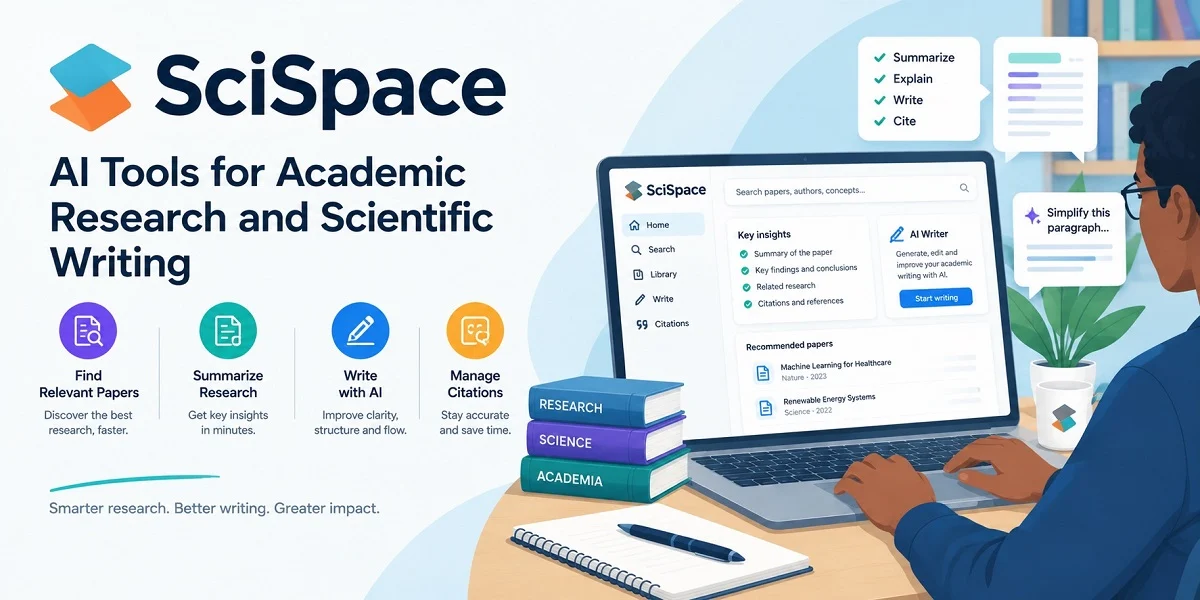
Understanding a scientific paper can take hours, especially when it contains unfamiliar terminology, complex methods, statistical results, or dense explanations. SciSpace helps researchers work through these challenges by combining academic search, AI-powered paper analysis, literature review tools, and research writing features in one platform.
It is designed for university students, postgraduate researchers, lecturers, scientists, and professionals who need to find and interpret published research. Instead of switching between several tools for every task, users can discover papers, examine their findings, organize evidence, and develop academic manuscripts within the same workspace.
Find Relevant Academic Papers
SciSpace helps users search scientific literature using natural-language questions and keywords. Its search combines semantic matching with text-based methods to identify papers relevant to a research topic.
The platform draws on academic sources and research repositories, helping users discover publications across different disciplines. Researchers can refine their searches, examine paper details, and follow relevant references to find additional studies.
This is useful when developing a dissertation topic, preparing a research proposal, or investigating a scientific question. However, researchers conducting comprehensive reviews should also search the specialist databases relevant to their field. No single search platform guarantees complete coverage of published research.
Understand Research Papers With AI
SciSpace’s Chat with PDF feature lets users ask questions about uploaded papers and available research documents. Rather than repeatedly searching through long PDFs, they can request explanations of specific concepts, methods, equations, findings, or conclusions.
For example, a postgraduate student studying analytical chemistry could ask how a paper’s analytical method works or why the authors selected a particular technique. A researcher comparing clinical studies could ask about sample characteristics or reported outcomes.
AI-generated explanations can make technical material easier to approach, particularly for readers who are new to a subject. Important interpretations should still be checked against the original paper, especially when discussing numerical results, limitations, or scientific claims.
Conduct Literature Reviews
Reviewing research involves more than collecting a list of publications. Researchers must identify relevant studies, compare their methods, organize findings, and determine where the evidence agrees or conflicts.
SciSpace’s Literature Review tools help users discover papers and organize information into structured tables. Customizable columns can capture details such as research objectives, methods, findings, and conclusions.
For more demanding projects, the platform offers deeper research and systematic literature review workflows. These can assist with screening papers, extracting data, and synthesizing evidence into reports. The available workflow and usage limits depend on the subscription plan.
These tools can reduce repetitive work, but researchers remain responsible for verifying study eligibility, checking extracted data, and documenting their methodology. A generated report should not be treated as a complete or validated systematic review without independent checks.
Write and Improve Academic Papers
SciSpace includes an AI Writer designed to support academic drafting and editing. Users can develop manuscript sections, refine sentences, improve readability, and receive citation suggestions while working on research documents.
The platform also offers citation generation, paraphrasing, and reference-management features. Integration with tools such as Zotero and EndNote can help researchers incorporate existing references into their workflow.
For researchers preparing journal submissions, SciSpace provides manuscript editing and formatting capabilities. Its writing workspace supports document preparation, academic templates, and export options intended to simplify the transition from draft to submission.
AI-generated writing still requires careful editing. Researchers should verify every citation, confirm that sources support the claims made, and follow their institution’s or journal’s rules on AI assistance and disclosure.
Extract Data and Explore Research Topics
Beyond searching and writing, SciSpace can help users extract information from research papers into structured formats. This is useful when comparing several studies or assembling evidence tables for a thesis, review, or research report.
Its topic-discovery features can also help users investigate unfamiliar concepts, identify related research areas, and develop more focused questions. These functions are particularly useful during the early stages of a research project.
Who Should Use SciSpace?
SciSpace is suitable for undergraduate and postgraduate students, academic researchers, university lecturers, scientific teams, and professionals who regularly work with technical publications.
Students can use it to understand difficult papers and organize sources for assignments. PhD candidates can use it to support literature reviews and manuscript preparation. Research teams can use its extraction and comparison tools to organize evidence across multiple publications.
The platform is best treated as a research assistant rather than an authority. Users should consult original studies, evaluate research quality, and verify AI-generated findings before citing or publishing them.
Pricing and Availability
SciSpace offers a free tier with limited access to selected tools, alongside paid subscriptions that provide higher usage limits and additional research capabilities. Paid features can include expanded PDF conversations, literature reviews, deeper research workflows, and manuscript tools.
Plans, credits, and feature availability vary. Visit the official SciSpace pricing page for current subscription details.
For anyone who regularly works with scientific literature, SciSpace provides a convenient workspace for discovering research, understanding complex papers, organizing evidence, and preparing academic writing. Its greatest value is reducing routine research work while keeping users connected to the published studies behind their findings.
Learn more about Scispace AI Research Tool: AI Writer and Literature Review.