

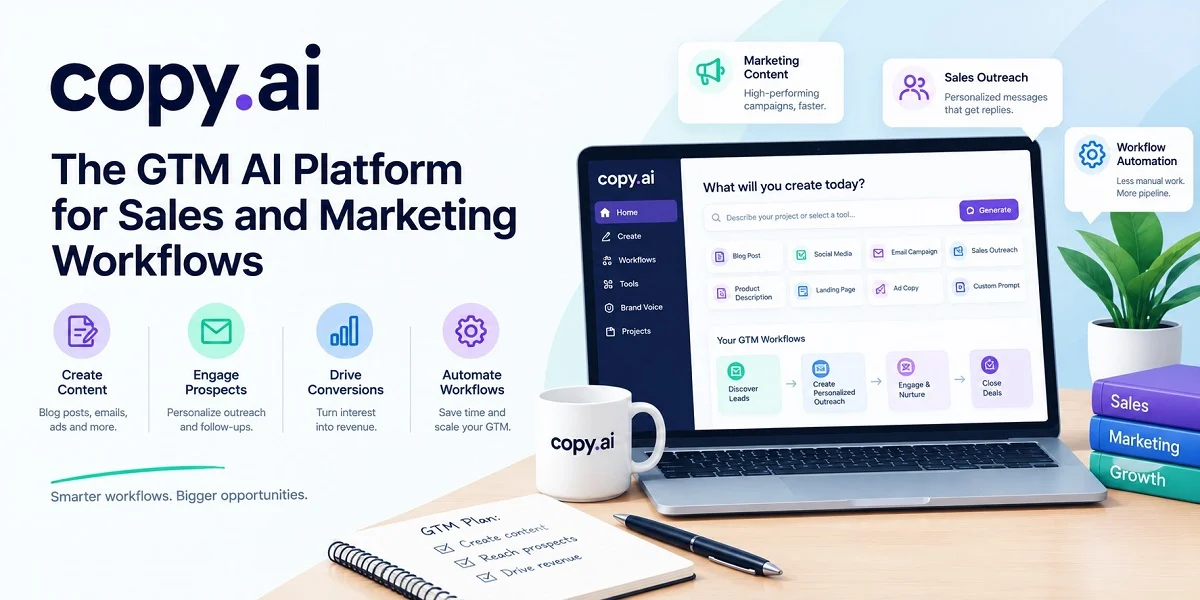
What Is Copy.ai?
Copy.ai launched in October 2020 as an AI writing tool for marketers. Today it runs as a go-to-market platform for sales, marketing and revenue teams. Copy.ai joined Fullcast in an acquisition announced on October 15, 2025. Paul Yacoubian and Chris Lu founded the company.
Fullcast is a revenue operations company. The deal pairs Copy.ai’s workflows with Fullcast’s planning, forecasting and compensation tools. Both firms describe the result as one connected platform for revenue teams. Fullcast’s announcement calls Copy.ai trusted by millions of users worldwide.
The platform automates repeatable sales and marketing processes. It chains steps into workflows that run on their own. Chat and brand tools remain in place for everyday writing.
Core Features
Workflows and Actions
Workflows chain modular actions into repeatable sequences. A team can enrich a lead list, draft personalized outreach and push the results to a CRM. Runs can start when data changes in a connected table. Teams manage these sequences centrally instead of in scattered prompts.
Copy.ai lists translation and localization as a use case. Its templates cover blogs, social posts and ad copy. Brand Voice keeps localized copy on tone.
Tables, Infobase and Brand Voice
Tables hold operational data in one place. Infobase stores company facts so outputs stay accurate. Brand Voice keeps tone consistent across sales and marketing copy. Together these layers ground every output in your own data.
Chat and Content Agents
Copy.ai Chat gives teams access to OpenAI, Anthropic and Gemini models in a shared workspace. Chat projects keep related conversations organized. Content Agent Studio lets teams train agents for their own content. Those agents then produce on-brand material at scale.
Security and Governance
Copy.ai maintains a public Trust Center for security details. Its blog also explains how automated workflows and SOC 2 compliance protect your data. Enterprise buyers can review both before a pilot.
Who Uses Copy.ai and How
Sales teams can use it for prospecting, inbound lead processing and deal coaching. Marketers can use it for account-based marketing, content creation and translation. Operations teams can use it for lead intelligence and CRM enrichment. The platform also orchestrates workflows for customer success teams.
The platform suits teams that repeat the same go-to-market process often. Solo writers who need occasional drafts may use only a fraction of it. Larger teams get the most from shared data and governed context. Copy.ai positions itself as a replacement for many disconnected AI copilots.
Its blog publishes practical guides on cold email, prospecting and thought leadership. A help center and changelog track product updates. Both are worth a look before you build your first workflow.
Pricing, Plans and Integrations
Copy.ai sells chat access by seat and automation by workflow credits. Complex workflows use more credits per run. Plans have changed over time, so check the pricing panel below and the current pricing documentation. Enterprise tiers require contacting sales.
It connects with CRMs and other go-to-market systems. Some workflows now ship as Fullcast Propel, powered by Copy.ai. Early access to those workflows is available on request. Fullcast now hosts the help documentation and API guides too.
Copy.ai fits revenue teams that want repeatable AI workflows instead of one-off drafts. Check credit costs before you scale a workflow. Start with one process and measure the results.
Learn more about Copy.AI: How Copy.ai works and Building workflows.